
1. Keith Fuller, The Auckland Grammar School War Memorial
2. Jill Richards, Glimpses of a Mt Eden Doctor: Dr J.F.G. Richards
3. Jim Millar, Early days of Presbyterianism in Epsom
4. Keith Fuller, The place of Riukiuta-Te Tatua (Three Kings)
5. G. Bush, I. Crabtree, J. Grant, World War II – through children’s eyes
6. John Stacpoole, Stone Houses: an address to the Epsom & Eden District Historical Society, 2001
7. Jeanette Grant, Pre-supermarket shopping
8. Muriel Williams, Dogs – an anecdote from the 1920s
9. Helen Laurenson, Were we amused? Some reflections on the theatre in Auckland in 1883
By Keith Fuller
Standing in an eye-catching position in front of the school’s main entry, and visible from the Southern Motorway, is the school’s War Memorial. It honours those men from the school who died in World Wars I and II.
There is probably little appreciation and understanding of the symbolic significance of its features. These are:
Bronze plates at the base of the shaft commemorate the 268 men of the school who died in the war of 1914-1918. In 1952, low walls were built on either side of the shaft and bear inscribed bronze plates commemorating the 335 men who died in the conflict of 1939-1945.
The architect for the design and additions to the monument was Mr W. Gummer.
[Source NZ Herald 13/11/1952]
Dr John Frederick Gwyther Richards lived in Milton Road, Mt Eden, for more than 40 years. His personality made such an impact during that period that even today he is remembered by many in Auckland and beyond. He was a family doctor of the old school, available to his patients at any hour, conducting, with his beloved wife Dorothy, evening surgeries at their home, and going on house calls daily. Many people believe they owe their lives to his knowledge and skill, and to the somewhat unorthodox treatments he developed, especially for asthma sufferers.
Who was this man that many people remember so vividly that I am identified as his daughter-in-law, rather than as myself?
John Frederick Gwyther Richards, known as ‘Fred’ by family, was born in Hunterville on 10 May 1887 to John and Euphemia Richards, their fourth child and only son. His father, John Gwyther Richards, was employed in a variety of roles, including bridge building and as dredgemaster in Westport, and moved around the country a great deal, so the children were born in four different towns. The family were living in Victoria Place, Wellington, by the time little J. F. G. was four years of age, in the house which had been occupied by his step-grandfather, Henry Hitch. Henry had met and married Elizabeth, (née Gwyther . . . hence the family name) in Australia after the death of Thomas Richards in 1857. Fred’s mother Euphemia, née Barnes, who had arrived in Nelson from Glasgow in 1863 with her father Robert and five sisters, was not to live to see Fred’s fifth birthday, as she succumbed to pneumonia on 28 October 1891.
His sisters, Eveline, Gertrude and Helen, assisted by family members in the early years, had the task of caring for Fred, and he received a very good education, moving from Willis Street school at the end of 1901 to attend Wellington College. There he excelled, not only graded ‘AA’ in character, but academically with many school prizes for Science and English, a Scholarship worth £20 and the Barnicoat Memorial prize in 1905. He was a prefect, Dux of the school in 1905 and gained the Medical Preliminary prize, an Ambulance certificate, and was Drill Secretary of the Cadets in the same year.
His medical studies began at Victoria University College and continued until 1907, in which year he was awarded the Sir George Grey Scholarship. He then pursued his medical training at Guys Hospital, London, where he gained a gold medal for surgery. The outbreak of World War I meant a change of plan, and the young doctor enlisted with the Royal Army Medical Corps and was sent almost at once to France. Later he joined the New Zealand Tunnelling Corps and was awarded the DSO for ‘distinguished service in the field’, was mentioned twice in despatches, and received the 1914-1915 Star, the British War Medal and the Victory medal.
After his discharge in 1919 he returned to New Zealand, and carried out some locum medical duties before returning to England for further training at Lewisham Hospital. He then settled in Mt Eden, living with his sister in the Milton Road house which had been purchased by his father about 1920. He also had a city practice in which he was active for many years, based in the Lister Buildings, Victoria Street.
On 6 May 1930, John F. G. Richards married a medical colleague, Dr Rosina Dorothy Crawley, and they enjoyed 35 years together at 8 Milton Road, where their two sons, John and Peter were born and raised.
In addition to medical duties, the Richards family were active members of the Dominion Road Church of Christ, John F. G. being a regular and compelling preacher (his wife keeping all his sermons) and, during World War II was National President of the Church of Christ for an extended term. He was a man of strong belief and a commanding figure, even in later years, as he led ‘grace before meals’. The ‘Richards Grace’ was not remarkable for its brevity, and son John was teased about this at later gatherings where, it was said, the meal grew cold. We are not sure where the grace originated, but the link with the Church of Christ is through Henry Hitch, mentioned earlier. John still uses this blessing at the table today.
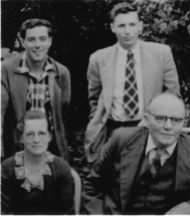
Back: Peter & John Richards Front: Dr Dorothy & Dr John Richards
Dr Richards held firm views on a number of subjects, including the ‘Evils of Alcohol’ and ‘Fluoridation of the Water Supply’, numerous leaflets being printed for distribution. He was always ready with carefully thought-out argument and enjoyed strong and lively discussion. I don’t think he would easily give way, for he was a formidable opponent and a somewhat daunting person on first acquaintance.
He provided generous support to family members, and his foresight in the purchase of land at the end of Redoubt Road, Manukau City, in the 1930s, provided a resource which was to pay off in later years. John and Peter, and other family members, spent many Saturdays ‘grubbing gorse’ on the site of what was to become ‘the farm’. Later Peter took over the farm and he and his family lived there until the rapid development of South Auckland led to the area being sold for housing. In 1951, in what might be regarded as still the ‘prime of life’ John F.G. was struck down with a form of rheumatoid arthritis, which left him virtually confined to a wheelchair, dependent on his caring and patient wife for many of the tasks of daily living. He did not, however, allow his illness to stop his medical calling, and continued to see patients at the Milton Road surgery, and as he accompanied ‘Mum’, as he called his devoted wife, on house calls, they were able to offer joint consultation to many of their patients.
When John and I were married in London in 1960, his parents were unable to attend, but we got plenty of advice and a warm welcome when we arrived in Auckland in early 1961. They rejoiced with us in the birth of their third grandchild, David, in 1962, Peter and Barbara Ann having already presented them with Megan and Mark. Another granddaughter, Bronwen, arrived, but sadly, John F.G. was not to see our two other children, Simon and Mary, as he died on 30 April 1965. Dr Richards was a proud and loving father of the ‘old school’, not very demonstrative and with high expectations and hopes for his sons. I am sure he was delighted that John chose a medical career, first in General Practice, and then at the Auckland Medical School. He would have been very happy to know that one grandson, David, continues the family medical tradition, that all that generation are doing well in their chosen fields, while the next, three boys and two girls, show every sign of developing into people who will make a worthwhile contribution to society.
In many ways John Frederick Gwyther Richards was ‘larger than life’, a man of many parts, and a citizen of which Mt Eden may be proud.
by Jim Millar
The Epsom Presbyterian Church was built in Gardner Road in 1906 at a time when urban as opposed to rural settlement was just beginning in the central isthmus along the main road from Auckland to Onehunga. The Presbyterians who lived on the farms in that area had been served for many years — from the mid l860s — by preachers from Onehunga. In particular the Reverend George Brown, MA, who would hold services in one or other of the various homesteads, usually that of Mr John Crawford with adherents congregating for week night services. An early site for a church was purchased from Mr James Macky in Onslow Road, but was later exchanged for a section further along the road owned by a Mr Chadwick. This proved to be unsuitable and it was not until February 1880, when a Weslyan Chapel was bought by Mr Gardner in Alba Road (then called Wattie’s Lane), that regular evening services were held and a Sunday morning ‘Sabbath’ School established under the superintendence of the Reverend George Brown. Two years later the Epsom Public Hall was erected in Manukau Road opposite the top of Onslow Road, and Sunday evening services were transferred there. The little ‘Wesleyan’ Chapel was shifted to the back of the Hall and used as a library.
From 1887 to 1893, the administration of the church was transferred from Onehunga to Remuera under the aegis of the Reverend G. B. Monro, with St Lukes taking responsibility for the Epsom Preaching Station, as it was called. It appears that there was considerable unease both on the part of the St Lukes Session on the one hand, which was somewhat alarmed at the rather ‘woolly’ organisation or lack of it that they perceived, and on the other the Epsom congregation who appear to have felt a lack of commitment from their new overlord. There seems to have been no accurate information regarding the numbers of Epsom people involved in the church, though the Reverend G. B. Monro reported that 14 communicants attended a service he conducted on 3 October, 1888.
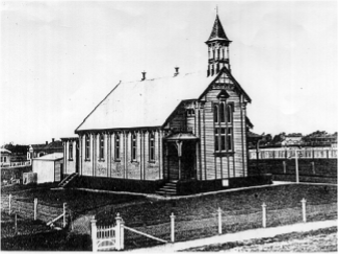
Front view of Epsom Presbyterian Church, 1906
In 1893 the oversight of the Epsom Mission Station (terminology seems to vary over the years) was transferred back to Onehunga, with the Reverend Robert Ferguson as Moderator. Services up to 1902 were by ‘voluntary effort’ except for three six-month occasions when student missionaries were engaged.
The Reverend R. F. McNicol was appointed minister for the Epsom Parish in 1902 and remained until 1907, by which time a church had been built on the present site. In the year of his appointment, a section had been purchased for £198.0.0 in Manukau Road (near Golf Road) from Mr Graham Waterman. However, by the beginning of 1905, after a well attended congregational meeting and a close vote, it was decided to sell this land and buy the present Gardner Road site for £297.0.0 from Mrs Gardner.
By the end of the year a Mr Penman’s tender of £738.10.0 to build the church had been accepted (he appears to have built it at a loss), and the foundation stone was laid by Mr John Crawford on 23 December, 1905. Three months later, on 31 March, 1906, the church was opened and dedicated by the Reverend A. Macaulay Campbell.
Ill-health caused the resignation of Reverend MacNicol and it was not until 1908 that the Reverend W. Trotter was inducted as the first minister of the Epsom Presbyterian Church and Parish. He remained in office until 1913.
The church opened with a debt on the building of £450.0.0, and a revenue from its 49 communicant members and 69 adherents of £220.0.0 per year.
At the inaugural service the Reverend Macaulay Caldwell preached ‘a very fine sermon, the subject being Christian Service. There was a splendid congregation, the church being full and the service altogether being very bright. At the conclusion of the service, afternoon tea was provided by the ladies of the congregation in a tent at the rear of the building’.
The services were continued on the Sunday following, when the Reverend George Brown (one of the originators of the Epsom Mission Station) preached in the morning, Mr Scott in the afternoon and the Reverend MacNicol in the evening.
The Parish boundaries were established in 1908 as follows: Mt Eden Road, Three Kings Road (Mt Albert Road), then down to Royal Oak across towards Great South Road and round by Market Road and Mt St Johns Avenue. Most of this area was still farmland, and the roads and streets that we know today would not have existed. Hence the rather imprecise boundary definition.
From today’s congregation (2002) Lou Dixon, now aged 84, who lives in the Golf Road house that she was born in and which her father built in l913, would have the longest association with the Epsom Presbyterian Church.
Some of the families that would have attended the church in the early 20th century include the following names: Agnew, Ambury, Anderson, Bell, Burns, Carnachan, Clark, Crawford, Cruickshank, Dahen, Dalton, Dinnison, Dickinson, Ferguson, Fitzgerald, Fordyce, Foubister, Gardner, Garley, Goodfellow, Gordon, Grandison, Gray, Grey, Halliday, Hamblen, Haslett, Haydon, Head, Hodge, Humphreys, Ireland, James, Jamieson, Jordan, Ker, Lamb, Lane, Lawne, Lipman, Littlejohn, Lund, McDonald, McGarum, McIlwraith, McLean, MacNicol, Makgill, Mime, Monro, Moore, Movus, Noviak, Patterson, Paul, Porter, Scott, Smart, Stehr, Tait, Taylor, Trotter, Walker, Whitehead, Worrall.
The first Session meeting held on 29 February, 1908, involved some well-known families and personalities in Auckland’s 19th and early 20th century history: Messrs Ker, Crawford, Cruickshank, Halliday, Haydon, Lane, McLean and Littlejohn. It was rather sad that Mr William Gardner, who was an outstanding worker for the church in earlier years, did not live to see the completion of the church on his land, Emerald Hill, as it was sometimes known. He died in 1899, but his widow and other members of his family attended for many years,
Sources
Pamphlet published by the Epsom Presbyterian Church on the occasion of its 75th Jubilee, 1981.
Unpublished Session and Managers’ Minutes of the Epsom Presbyterian Church. Unpublished Session Minutes of St Lukes Church, Remuera.
By Keith Fuller
A solitary scoria cone, disfigured by the water reservoir on its summit, is all that remains of a once comprehensive cluster of volcanic scoria cones and mounds. To Maori, they were known as Te Tatua a Riukiuta (Te Tatua) — ‘the belt or girdle of Riukiuta’.
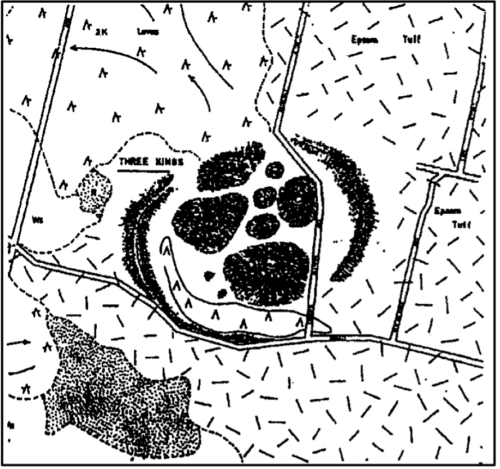
Te Tatua a Riukiuta.
Named by Felton Mathew in 1841 ‘The Kings’.
Renamed 1848 ‘The Three Kings’.
Today the other cones and mounds that were a feature of this collection of volcanic structures have been quarried away. Quarrying at Three Kings continues, Winstone Aggregates Ltd having a Resource Consent which allows them the right to mine and process scoria until the year 2010 on the subterranean site of the once southern king (Taurangi).
Of all the original cones and mounds, today only the western Cone remains. Over time it has become known as the ‘Big King’ rather than by its rightful name the ‘Great King’.
The Big King is protected by reserve status. The reserve is 7.2ha in size and is administered by the Auckland City Council. All the other cones and mounds have been quarried away. Open cast mining of scoria by Messrs Winstone Aggregates Ltd is a permitted business activity at their quarry site. Extension of any quarrying activity onto reserve land would have to become the subject of resource consent.
Of all the original cones and mounds, today only the western cone remains. Over time it has become known as the ‘Big King’ rather than by its rightful name the ‘Great King’.
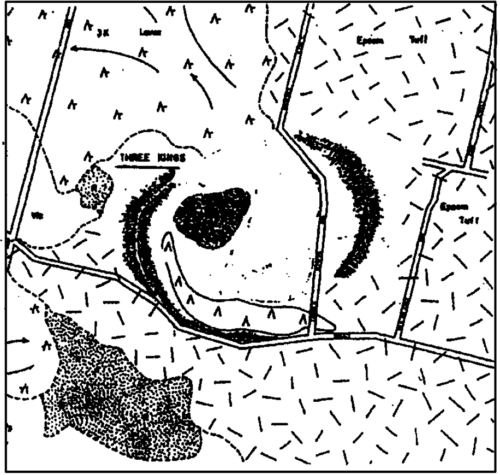
The volcanic explosions that created Te Tatua a Riukiuta are thought to have started 15,000 to 20,000 years ago. The initial explosion was one of immense physical force, excavating a crater some 200 to 300 metres deep, and approximately 800 metres wide. In practical terms the crater enclosed an area from Mt Albert Road in the south to Landscape Road in the north, to the west McCullough Avenue and St Andrews Road in the east. The explosion(s) spread volcanic dust (ash) over a wide geographical area, as well as building up the tuff ring (a prominent rim of consolidated ash encircling the explosion crater). A laval lake formed. This slowly solidified, only to be blasted open from time to time by renewed outbursts of volcanic activity. As these eruptive forces became passive, lava fountaining from more than a dozen places within the crater built up a collection of volcanic structures. Three scoria cones became conspicuous, and eventually in 1848 gave rise to the European name, Three Kings.
Little by way of legend is known about the tribe Ngai-Riukiuta, who apparently first settled Three Kings. It is thought they were a sub-tribe of Ngati-Huarere of Moehau (Cape Colville). The same people are alleged to have occupied villages at Okahu Bay (Orakei), Horotiu (near the Auckland Town Hall), Fort Britomart and possibly other places on Tamaki-Makau-Rau. The Three Kings pa was known as, Te Tatua a Riukiuta (‘the belt or girdle of Riukiuta’) ‘because the hills formed a group around the central citadel of Te Tatua a Mataoho’ (the western cone). This pa was also known as Nga Pare Toka A Rauiti (‘the stone parapets of Rauiti’). Rauiti, believed to be a brother of Riukiuta, is said ‘to have enclosed his pa with stone walls rather than using pallisading’. By the fourteenth century Arawa had taken possession of Tamaki-Makau-Rau, ‘Tamaki of many lovers’, the general name for the Auckland isthmus, so named because tribes were continually at war for its possession. The occupation of Te Tatua a Riukiuta seems to have ended some time between 1750 and 1790. From 1860, the hills of Three Kings were farmed.
The current pakeha name(s) for the surviving western cone of Three Kings — Big King — is very questionable. Confusion also exists about the correct names of the other two cones which have been quarried away.
George Graham in his list of ‘Maori Place Names of Auckland’ (1929) records the eastern cone as ‘Koheraunui — a hill on the south-east side of Three Kings now almost quarried away (Koheranui)’ (N42277534).
David Simmons in his book Maori Auckland, states it was ‘Koheraunui, the big leafed Kohe tree, or to the pakeha the Big King. It was quarried away for railway ballast’. He names the southern cone as Taurangi (also quarried off, but now being open cast mined to sea level) and the western or centre cone, Te Tatua a Mataoho. This is the protected and sole surviving cone of the original collection of the volcanic structures forming Three Kings. To the Wesleyan Church to whom it belonged (1845-1927) it was known as the Great King.
Felton Mathew, Captain Hobson’s surveyor, trig surveyed the Auckland isthmus in 1841. He called Te Tatua a Riukiuta ‘The Kings’.
The earliest official reference to ‘Three Kings’ is alleged to be in an old deed of 1848. However it was earlier, in 1845, that Fitzroy, as governor, granted the Wesleyan Church some 192 acres of farmland at Three Kings for educating natives. This land grant included Te Tatua a Mataoho — the centre or western cone of Three Kings.
Had Felton Mathew’s name ‘The Kings’ by unthinking, but now by established common use, become known as the Three Kings? Did the deed of 1848 formally endorse this name?
The purpose of Fitzroy’s land grant as made to the Wesleyan Mission was ‘to train selected Maori to become efficient teachers of their countrymen’. The school was called ‘The Three Kings Wesleyan Native Institution’ (later Three Kings College). The school in its original form was short-lived, closing in 1869 as a result of the land wars of the 1860s. It re-opened in 1876, but shifted to Paerata in 1923 (Wesley College). In 1927 the Great King (centre or western king) which was part of the school’s property (being a little over ten acres in extent) was set aside by the school trust board as a reserve, and vested in the crown. Fourteen acres of bush, also given, has been built upon. In 1939 all the remaining school property was sold to the State for housing. H. A. H. Insull, in ‘The Three Kings Native Institution: a sketch history of Wesley College in Grafton, at Three Kings, Mt Eden, and at Paerata in the Franklin County 1844-1974’, Auckland-Waikato Historical Journal, October
1974, No. 25, writes
Three Kings Wesleyan Native Institution, as it was called, took its name from a group of small volcanic cones, two of which have been almost obliterated by quarries, but the Great King, which was part of the college property was set aside by the Trust Board as a reserve and vested in the Crown. Thus it will be preserved to the district for all time.
E.W. Hames, in his publication, From Grafton to Three Kings to Paerata: A history of Wesley College, Auckland, New Zealand from 1844 to 1982, reiterated Insull’s statement (Chapter 5).
That the correct names for the original collection of volcanic structures of Three Kings be recognized as follows:
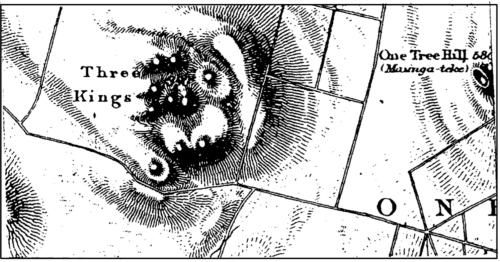
Enclosed within their tuff ring, the nine volcanic structures of Three Kings (Te Tatua a Riukiuta). A tenth structure is outside the ring. This portrayal of the Three Kings has been copied from a 1920 British Admiralty Chart of the Manukau Harbour.
Why did Felton Mathew name the former collection of seven volcanic structures which we know as Three Kings, The Kings? Did they possibly remind him of similar laval features seen in his home country or elsewhere in the world? It has been written that both names have biblical roots. Seemingly, Christmas carols have been responsible for the belief that the ‘Three Wise Men’ who carried the gifts of gold, frankincense and myrrh to the boy Christ were kings. Biblical scholars think they were more likely astrologers! The biblical testaments record there being nine or more kings!
Notes
By Graham Bush
In 1941 (?) my father built a quite elaborate air raid shelter in our back garden. It was lined, had bench seats for about eight people and the roof was covered by about a foot of soil. Of course it thankfully never saw active service, but as an eight year old, I and my neighbourhood boyfriends had much fun in employing it as a hideaway, an HQ for planning forays against other youngsters and a retreat during sudden rainstorms. Much to my regret, my father filled it in once the threat of bombing by Japanese airplanes ended.
Throughout World War II, I was a pupil at the Epsom Normal Primary School. The playing fields were then terraced and in 1942 the Education Board had air raid shelters constructed in at least one of the slopes between terraces. The occasional practice at emergency evac-uation of the classrooms and hightailing it into the shelters, complete with ear muffs and numbered seats, was a welcome relief from lessons. During the war there were acute shortages of basic foods and materials and one of the female teachers at Epsom Normal Primary gained quite a reputation for her adeptness at ‘cadging’ such goods. Ostensibly, requests went to parents for items needed for classroom activities. But eventually it became evident that a goodly proportion of these were appropriated by the teacher to meet her personal needs.
Aucklanders were encouraged to provide home hospitality for United States troops who passed through the city in such great numbers on their way to or from Pacific battlefields. I recollect my father bring-ing several to our family home. They always brought a generous supply of ‘goodies’, such as cigarettes like ‘Camel’ or ‘Philip Morris’ for the adults and chewing gum, toffee bars or regimental emblems for the drooling youngsters. My seventh heaven arrived in 1944 when a Marine gave me his tropical sun helmet, which is still in my possession. It was decorated with the names of islands and battles he had experi-enced — Pearl Harbour, Guadalcanal, Midway and Wake. As inscribed on the headgear, his details were ‘Sgt Thomas M. F. Knight, Browns-ville, Tennessee, God’s Country’.
Shortly after it became clear that the war was likely to be protracted. Rationing for meat, butter, sugar and petrol was progressively introduced. At their most severe, rationing restrictions really bit into a reasonable standard of living. Children wearing ‘uniforms’ made out of sugar sacks, and newspapers cut up into toilet paper were every day occurrences.
My entire primary schooling was a ‘barefoot job’, partly because of footwear shortages and partly because my parents felt it hardened my sole(s). Getting ration coupons above one’s legal entitlement was greatly prized, but no more so than access to imported spirits, and my father helped manage the office of a wine and spirits firm in Albert Street. Concepts like the black market and backhanders only came to me later, and on reflection I realised that the generous supply of ration coupons our family usually had at its disposal were actually the quid pro quo for the additional brandy, whisky or gin which my father supplied to some of Cooke & Co’s more affluent and influential customers.
By Ian Crabtree
The story of New Zealand’s first ‘atomic bomb’ has not so far been told, and I therefore write it down before the story passes from my memory. In 1943, an invasion of New Zealand by the Japanese was thought to be a real threat. People were required to dig slit trenches in their gardens so that they would have some protection should an aerial attack take place. There were anti-aircraft gun batteries at Auckland to counter the threat, and I was aware of the location of two of these batteries. One, of 3.7 inch guns, was at Bastion Point and the other, of smaller Bofors guns, was near Mt Albert.
The Army was concerned about the vulnerability of the people operating the anti-aircraft guns. A decision was made to train a group from Auckland Grammar School so that they could if necessary operate the guns. The group chosen was Auckland Grammar School Form 4A. Presumably a more senior class was not chosen, as the Army wanted a group that could be available from the school for several years.
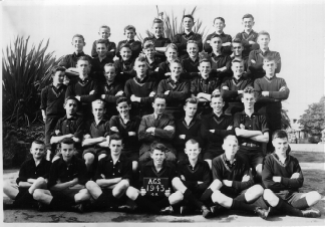
4A, Auckland Grammar School, 1943.
The author is in the third row, third from the right.
The 3.7 inch guns were the more difficult to operate and training was focused on them. Training on these guns took place each week during what would normally have been the two adjacent periods of a maths class. As the previous class finished, army trucks would arrive at the school, 4A would be driven to Bastion Point for training, then back to school in time for lunch.
For a 3.7 inch shell to destroy an aircraft it needs to explode close to the aircraft concerned. To achieve this, the anti-aircraft gun battery had a ‘predictor’ designed to provide information for aiming and firing the guns. The predictor was a free standing metal ‘box’ which could be rotated on its stand. It had numerous handles and dials and was operated by four people, with one person operating at each side. It had two telescopes through which the operators followed the targeted aircraft. The predictor was in effect a large ‘black box’, which worked out the angle and direction that the guns should be pointed and the time at which the fuse should be set for the shell to explode near the aircraft. We learnt to operate the predictor, to pass the information over to the gun crews, to set the information on the guns and to fire the guns. We were keen to have a live shoot with the 3.7 inch guns but were never permitted to do so. However, the school artillery company did have live shoots with 25 pounder guns at targets in the Manukau Harbour. The aim was to hit the water near the target (a raft of oil drums) but not to hit the target itself because it would then have to be replaced. Needless to say the target was hit, much to the annoyance of the permanent army staff who organised the shoot and who would have to prepare another target.
Some distance away from the 3.7 guns on which we trained there was a dummy battery. It consisted of wooden replicas of the real guns and was designed to confuse attacking aircraft. I asked how the gun flashes were simulated and was told this was done by adding a drop of concentrated sulphuric acid to a mixture of potassium chlorate and sugar. There would be a slight delay after adding the acid and then there would be a brilliant flash. I tried out the mixture at home and found it worked extremely well.
The training at Bastion Point continued for some months. We also had a visit to the Mt Albert Bofors battery to learn how to operate the guns located there. Later that year (1943) the Japanese threat receded and 4A no longer went to Bastion Point for training. Back to less exciting maths.
In 1945 the Kitchener Boy Scout Troop (based at Mt Eden Presbyterian Church) was invited to a social evening by the Girl Guides at St Barnabas Anglican Church also in Mt Eden. The scouts were asked to provide some entertainment. One of the items devised involved an ‘atomic bomb’ explosion. I did science at Auckland Grammar School and was asked to provide the bomb. I thought that the potassium chlorate sugar mixture was the best way to provide the effect required and I prepared a bomb.
The social evening was held at St Barnabas Church hall. During the scouts’ item, the bomb was placed on an elegant table at the centre of the stage. At an appropriate time I crept forward and put a drop of sulphuric acid on the bomb mixture. Nothing happened — or it seemed to me that nothing happened — a potential disaster! I therefore crept forward again and in desperation put a considerable quantity of acid on the mixture. The next instant the bomb went off with a great flash, and a great cloud of white smoke enveloped the stage.
The cloud cleared and everyone, I think, was satisfied with the explosion. But after the show, the table top was covered with debris. When this was wiped away, the highly polished table top was seen to be totally covered with deep black burn marks. The sulphuric acid had been sprayed all over the table top by the bomb and to some extent on to the stage itself.
I was not aware of an official complaint by St Barnabas, but this was our first and last social occasion with the Girl Guides.
By Jeanette Grant
We were luckier than many families, for when my father was called up (at the age of 40) he was tagged for Home Duties only. He spent a couple of years stationed on the guns on North Head and so was actually able to come home when he was on leave. One of my earliest dateable memories is from this time. I was three years old at the most when he had some leave and took us down to the Tamaki Drive one evening when they were having target practice. I can still visualise the searchlights and the orange flashes from the guns firing on North Head and the point by the Tamaki Yacht Club. Afterwards we went up a flight of steps on the cliff face and inside the cliff itself to the generator room. The big curved silvery shapes of the generators were much taller than I was. Memory is odd. I can still visualise the bolts holding them down to the concrete floor. Fifty years later, the steps have gone but the bricked up doorway is still visible in the cliff face and the concrete shapes of the searchlight emplacements covered with graffiti have not changed much. Dad’s influence had a couple of odd side effects. The first songs that I learnt that were not nursery rhymes were ‘Mademoiselle from Armentiers’ and ‘The long and the short and the tall’. And as for the future? I can remember at the age of four wanting to grow up to be a sniper!
Soon after Pearl Harbour, the Education Gazette issued instructions that all schools prepare air raid shelters for use in case of the threatened Japanese invasion. The schools duly dug trenches, issued all the children with name badges, a cork to bite on and cotton wool to put in their ears. My mother had gone back teaching, as conscription had taken many male teachers out of the classroom. She was at Owairaka when they had their first Air Raid Drill. Oh dear! They had dug trenches for the children all right, but they had forgotten to dig any deep enough to hold the teachers! We also had an air raid shelter at home. It was very basic. Just a hole in the ground with earthen baulks to sit on covered in sacking. There was a little trellis-sided summer-house in the back yard. Dad dug the air raid trench directly under that so that it had a roof and did not fill up with water.
Defence preparations included making arrangements for alternative accommodation for all those school children who lived on the far side of the Great North Road. In the event of an actual invasion this would be the main route for military movements and there was no way children would be able to cross it to get home from school. This was all very thoughtful, but no one thought it necessary to make similar arrangements for any staff (like Mum) who might happen to live on the other side of the road.
We lived in a small ‘modern’ house with two storeys and dormer windows. The upstairs rooms had sloping ceilings and big cupboards under the eaves which my mother always called cubby holes. One of them off the bathroom contained her treasure — a sack of sugar. With wartime rationing in force, this reserve was a lifesaver. I remember it well. It was a real sack and there was a small hole in it, just the size of a little finger. She was also lucky enough to be the possessor of several pounds of butter. Unfortunately we did not own a fridge so the butter lived in her cousin’s refrigerator over in Wanganui Ave, Ponsonby. Collecting any involved a fourpenny tram trip into town and out to Ponsonby and back again. All for a pound of butter worth two shillings!
by John Stacpoole
I thought for this talk it would be best to go back to beginnings and, instead of discussing some of the well-known places of Epsom, which have already been recorded pretty thoroughly, I would speak about early stone buildings which were to be found more often in Mt Eden than in Epsom.
The ones I am going to speak about particularly are Eden Hill which was designed by William Mason in 1844, Rochleigh which is the house depicted in the watercolour I have brought along, and Upperhampton Villa and Manuka Grove. They were all built of stone. I will say something, too, about Mason’s Mill.
As you know, Auckland grew very fast in the 1840s and once the Government had sold off the town sections they moved to sell small farms which were mostly in the area between Manukau Road and Mt Eden Road. The auctioning of those small farms was put in the hands of William Mason and Thomas Paton who were in partnership in Queen Street. Mason was an architect and Paton had been the Auckland Postmaster. They invested themselves and took up three small farms of 19 or 20 acres each, and those three farms were in the area of Pencarrow Avenue extending west or south-west to Glenalmond Road. Mason took the land nearest to the City, north-east of Pencarrow Avenue, and Mason and Paton in partnership took the remainder.
Mason built a house on his property and called it Eden Grove. We don’t know a lot about his house because it was burnt down in 1845. All we know is that it was described as ‘a pretty cottage orné’ and that it had a shingle roof. The shingle roof was the cause of the fire, for sparks fell from the chimney to the roof and set it alight. Its destruction seems to imply that the house was built of wood rather than stone.
But we do know quite a lot about Thomas Paton’s house, which survived until 1955. It was just back from Balmoral Road in the area of what is now 5 Morvern Road. Thomas Paton eventually accumulated more than 100 acres stretching from St Andrews Road to Mt Eden Road and from Pencarrow Avenue to Watling Street. Some years ago an Auckland stamp dealer happened upon letters written by Paton to his cousin George Brown in Suffolk. Fortunately for us he bought the letters for their stamps and made their contents known in the stamp collectors’ publication, The Mail Coach. In one of the letters Paton described in some detail the construction of his house, built largely by himself.
Surprisingly the house had a tower. The tower cannot have lasted very long but Paton drew a little sketch of it — an octagonal tower at the back of the house, about three storeys high, which gave him a wonderful view of the entrance to the harbour — presumably the Manukau Harbour which he would have seen round the shoulder of the Three Kings.
He noted that ‘the structure was scoria stone to a height of three feet, then wood and mud, stone and brick chimney, well plastered and harled outside and difficult to distinguish from an entirely stone house’. It’s interesting that mud bricks or pisé played a part. He called the house Eden Hill and it stood there until 1955, so it lasted well. He had a visit from Mrs Hobson just before she left New Zealand and he told his cousin that she admired it very much. He claimed that the house was perhaps stylish and that it was regarded as the prettiest house in the settlement. For that he could thank his friend William Mason who designed it. He also preened himself that the cost was only £60 because of all the construction work he himself had done.
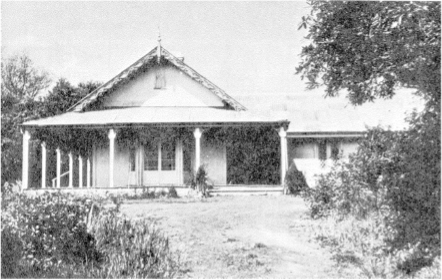
Eden Hill
Mason felt that with the growth of settlement and people planting crops there was an opportunity to put up a mill to grind their grain and he accordingly built the stone windmill which he called Eden Mill on the high land where today’s Windmill Road takes an almost right angle bend. Mason had a wonderful eye for situation. His own house, Eden Grove, was across the valley on land which one would now approach from a right-of-way beside Number 6 Pencarrow Avenue. The outlook is straight across to Mt Eden. The stone mill tower with the little lake below it, where the playing field is now, formed with the mountain a view of such picturesqueness that both John Kinder and J.B.C. Hoyte came to paint it. Mason eventually went to live at Queenstown and then to Paradise Flat at the head of the lake, between Mt Alfred and Mt Earnslaw, overlooking the Dart Valley. He gave the house he built there the same name he had given to his Mt Eden house, Eden Grove. This time the outlook was grand rather than picturesque, a little closer to heaven.
Mason’s mill was opened in 1844, and we get the Southern Cross commenting in August that ‘The new flour mill of Mr Mason is a very conspicuous and very satisfactory object and has, we doubt not, had a very great effect to stimulate the settlers of Epsom to exert themselves in the very praiseworthy manner that they have done.’ One of these settlers was the Potter of Potter’s Paddock, and the Southern Cross, in the same article, noted that ‘Mr Potter’s new house is very tastefully built and is certainly an ornament to Epsom.’ Potter’s was quite a formal little house, also of stone. It was moved some years ago to Western Springs.
An advertisement in the New Zealander for the sale of the mill at the end of November 1845 noted that it was built of scoria and that every part was of the best material, ‘the proprietor having spared neither time nor expense to render it the most pleasing of its kind in the colony. It contains one pair of French Burr stones, smutting and dressing machines and all that would be necessary to carry on the lucrative business of a miller. The mill has ground and cleared in a day one hundred bushels of wheat. There is also attached a weatherboard store and miller’s house. It is hardly necessary for the auctioneer to point out that the extensive districts of the Tamaki and Epsom are almost entirely dependent on this mill for getting their wheat ground.’ It was first sold to the Rev Walter Lawry as an investment, and then to John Bycroft who retained it for seventeen years. So much for Eden Grove, Eden Hill and Eden Mill.
I think I would like to talk next about Rochleigh. It was a very interesting house built by Robert Bleazard in or about 1855. The land had been taken up by John Kelly, an Irishman from County Tyrone. Kelly is an interesting figure in himself. He joined the Royal Engineers and went out to Australia where he supervised the construction of Government buildings in New South Wales and Tasmania. In 1836 at the age of 29 he came over to the Bay of Islands and worked as a surveyor there. I suspect that a number of the early buildings in the Bay were to his design. Certain characteristics of Edward Marsh Williams’ house at Puketona lead me to think that it may have been his work.
In Russell, Kelly fought a duel with Charles Babington Brewer, a barrister who was one more member of the strange mix of people to be found there. Brewer’s name had been coupled with a local girl, surely a Maori girl, which did not please him, and when Kelly ragged him about it he said, ‘This man has coupled my name with her and if he does so again I’ll call him out.’ Kelly continued to rag him and Brewer made good his threat. So they fought a duel with pistols. The first shots had no effect on either of them. Brewer demanded another exchange and this time his left whisker was shot away. The Encyclopedia of New Zealand says his wig was partly shot away but I don’t believe a young man in Russell at that time would have been wearing a wig.
John Kelly came down to Auckland in 1843 and bought all the land now enclosed by Mt Eden Road and Normanby Road and also a triangle of land to the west of that. The first block contained 66 acres, and the triangle another 50. He built a house on it but I haven’t yet identified its exact location. There is a Kelly Street in the area, and at the end of Kelly Street there is a big old bungalow which is obviously older than one would at first suspect. It is disguised by two later projecting bay windows to the front. If, however, you look at the side of the house you will see another bay window of a very different and earlier character, like the bay windows you sometimes see on very early houses in the Bay of Islands. Unfortunately Kelly Street doesn’t seem to be quite on Kelly’s land. More investigation is needed.
Kelly sold 14 acres of the triangle of land to that Thomas Parr who eventually built Albion Vale at Oratia. Parr sold his 14 acres to Robert Bleazard who had come from Canada via Australia and had been a goldminer in both countries. He was married, already had a family, and proceeded to build this extraordinarily interesting house which he called Rochleigh. It was demolished in 1967 with some protest — quite a lot of protest. The whole house was stone but plastered so that it did not reveal its basic material. The stone walls were 20 inches thick to which the plastering added another inch and a half. There were French doors right round the house — no conventional windows — but French doors with cedar shutters, beautifully made, which folded back in to reveal the opening. The house was single storeyed under two pyramid roofs, the front one slightly higher than the back one. At the peak of the higher roof was a glazed lantern or skylight over a single attic room. In photographs taken shortly before its demolition the house looks very plain but that is because much ornamental woodwork had been removed. The paired verandah posts had decorative cuts between them, which you can just pick up if you look carefully at the watercolour done by a Bleazard daughter in 1873.
There were three Bleazard daughters and one son who died young. The three daughters were Harriet, who is the forebear of the St Clair Brown family, Clara and Eden Emma. Both Clara and Eden were painters — the painting of the house is by Eden. Bleazard got involved with gold mining at Thames and coal mining nearby but he kept his house at Mt Eden, travelling frequently to and fro. Clara and Eden travelled in Europe, sketching as they went — their sketchbooks are still extant. When Bleazard died in 1886 Rochleigh was inherited by Harriet and her husband John Brown, who sold it to Walter James Potter in 1898. When it was demolished it was in the hands of the Presbyterian Charitable Trust. I don’t find church bodies very good custodians of heritage properties. The Pah has done very well but opposite me in Arney Road the old Campbell house, bequeathed to the Anglican church, has been recently sold for removal so I’m feeling sour about church custodianship at present.
However, I had hoped that someone here this evening might know of members of the Kelly family still about. John Kelly’s obituary in 1883 said that he had built a house on his property at Mt Eden in 1843 and lived in it till his death 40 years later. So the house must have survived until 1883 and probably much longer. It may just be the house at the end of Kelly Street. But he had eleven children and his obituary suggests that they were also prolific. So there should be a lot of Kelly descendants. If any of you come across them it would be interesting to hear what they have to say.
The other two properties that I’m going to talk about belonged to the Coldicutt family. William Coldicutt came out in 1844 in the Osprey and bought in 1845 the property on Mt Eden Road, some 20 acres, which he called Manuka Grove. We know that name only because his son was described as the son of William Coldicutt of Manuka Grove when he was married in 1865. This is the stone house at No 753, lately known as Blink Bonnie, a name given to it by the antique dealer John Waldie who lived there in the 1960s. Waldie also placed the date 1844 over the door but it was certainly not built in 1844.
Coldicutt is described in electoral rolls of the 1850s as occupying a raupo house and we believe that the stone house, Manuka Grove, was built in 1863 after his death in the previous year. It may have been built for the next recorded landowner, George Nairn, but the property had returned to the estate of William Coldicutt in 1868 prior to its sale to the Joughin family.
Across the road is Upperhampton Villa, also built on Coldicutt land. There has been a lot of argument about these two houses because of a man named Murdoch Welch. Murdoch Welch was a grandson of Donald Sinclair, a stonemason who emigrated from Dingwall, Inverness, leaving in 1862 and arriving in Auckland in 1863. According to Welch his brother Murdoch was also a stonemason and they together built 753 Mt Eden Road in 1863 and Upperhampton Villa in 1865, and he insisted that his family lived in both houses. Well, we believe him that his forebears built the houses and may have occupied them under construction and shortly afterwards, but their occupation prior to their sale in 1868 for one and 1877 for the other remains uncertain. Upperhampton Villa was built on the corner of Watling Street and Mt Eden Road on a property which had been taken up originally by George Cooper, Governor Hobson’s Colonial Treasurer. Cooper not only made a bad job of being Colonial Treasurer but he made a bad job of his own finances and had to be bailed out. Hobson took a mortgage over his property, 20 acres in extent stretching from Watling Street to St Leonards Road in one direction and from Mt Eden Road to St Andrews Road in the other. It was eventually sold to Dr Arthur Guyon Purchas — incidentally a trustee 20 years later, with Thomas Paton of Eden Hill, of William Coldicutt’s estate — and Purchas cut it up in 1848.
Coldicutt bought the Mt Eden Road frontage amounting almost to five acres and also a one acre lot facing St Leonards Road. Upperhampton Villa is a very plain house, not a pretty house at all. Manuka Grove, on the other hand, is both more traditional and better proportioned and it has had modifying additions such as the entrance porch. It’s interesting that both it and Rochleigh have very strong links to Australian buildings, Rochleigh in particular. You’ll find very similar houses in Tasmania, New South Wales and even Western Australia and you’ll find others of the same form as Manuka Grove without all its nice little decorative additions. It was very traditional, vernacular Georgian, where Rochleigh, under its tent-like roofs, had more of the grace of the Regency.
The Coldicutts are quite interesting. William came out originally to the Manukau Timber Company which planned to operate at Cornwallis with headquarters at Onehunga. There is a house at 22 Arthur Street, on the corner of Symonds Street, which is very early and is said to have been built for the Timber Company’s agent, W. C. Symonds. In 1841, however, Symonds drowned in the Manukau and the timber company folded. Coldicutt became interested in farming, hence Manuka Grove, and his sons took up other occupations. The family is still represented in the South Auckland area and was at one time, I think, at Orua Bay or Clark’s Beach.
Curiously William Coldicutt was listed at Cabbage Tree Road in 1855. It seems that this may have been an early name for Broadway south of Newmarket, where there was a famous cabbage tree cut down in 1908 during the widening of the Newmarket/Onehunga road. It was called Te Ti Totahi, ‘the cabbage tree standing alone’. Venerated by Maori it stood on what is now the corner of Morrow street and Broadway and, in the former garden of Colonel Morrow at 28 Almorah Road there is a cabbage tree grown from one of its heads.
I don’t know the origin of the name Upperhampton. It could be related to the village of Hampton where Hampton Court is, but there is another Hampton in Warwickshire and several more elsewhere. It probably relates to the place the Coldicutts came from. Upperhampton Villa was sold to a man named Alfred Reynolds who was described as a lapidary and I think he was the one in Victoria street who produced greenstone articles for tourists. King Tawhiao visited his shop during his Auckland stay in January 1882. Reynolds sold the house to the Fowler family who were master plumbers, well known in Auckland.
Perhaps I should mention some of the sources of information about all these houses and properties. Mostly the Land Records, of course, but other records you may find extremely useful are the Valuation Rolls and the Eden Electoral Roll for 1878/79 which lists all property owners. It extends to Mt Albert and parts of Remuera. It’s very useful for checking where people lived at the time and it is available in the Auckland Public Library. The Valuation Roll for 1897 — The Valuation and Rateable Property in the Epsom Road District 1897 — provides a map with all properties marked and numbered and listed with the owners’ names. These rolls are with the Valuation Department.
You must go back to these early sources for accurate information. It is tedious that the Land Registry is now split up, so that maps are now at Otahuhu while title books are at Federal Street and you have to go from one to the other. But if you really want to know you simply have to do this ‘hard yacker’ and follow your instinct to tell you where to go next. I had great trouble years ago working out the ownership of The Pines property — just who built the original house known as The Pines. We could go back to land records and work all that out, yet there was great confusion because there were two separate families of Sinclair involved with it and members of the Bloomfield family — owners in the 1930s— saying ‘yes, Andrew Sinclair built the house, absolutely positive’ which, of course, he did not. Nor did the other Sinclairs who went from Banks Peninsula to Hawaii, a very interesting story indeed, and returned to New Zealand to live 12 years at The Pines — two families of Sinclairs quite unrelated.
I believe that The Pines was built by Edward King or possibly Albert Beetham, both notable men. Albert Beetham, who was the first chairman of the South British Insurance Company, bought the land in the 1860s, called it Highfield, and planted the pines on that side of Mt Eden. But he did not stay long, selling to Edward King who had made money gold mining in Victoria, then set up here as a merchant, got involved with coal mining at Papakura and paid for the building of Christ Church there. He was close to Bishop Selwyn. Having bought Highfield from Beetham, he built a substantial house which, I believe, was the old wooden house we knew as The Pines. But he died soon after. He was unmarried, the chief mourner at his funeral being his neighbour, a man named Paterson, who owned the property now occupied as Government House. After his friend’s death (Bishop Selwyn took the funeral service) Paterson seems to have disappeared from sight. His property was sold to the Heathers and all that we have to remember him by are the Norfolk Island pines he planted close to Mountain Road.
Not far away, George Burgoyne Owen at Brightside was a great plantsman and gave trees to people round about, trees he had imported from Europe and Australia. Many trees go back to Owen in that area, including the Queensland kauri on Owens Road and descendants of the camellias which he was the first to grow.
The first part of Brightside, incidentally, was a square single-storeyed house with an attic floor. It was designed by William Mason whom we talked about at Eden Grove, and it was built in 1856 at the same time as Old Government House, also designed by Mason. You get these links running through Auckland history.
I have diverged considerably from stone houses as a topic so I should, perhaps, add that there was a stone cottage in Owens road, at the foot of The Pines land, which was extended some years ago to make a very attractive house for the Gunn family. Its origin is obscure. All these Epsom houses are extremely interesting and they all had interesting owners. You are right to think about the owners as well as the houses they lived in. St John’s Wood, Marivare, Florence Court, Highwic, Birdgrove, Prospect — there are lots more, some of them like Manuka Grove mere cottages, others grander. Don’t just believe what you are casually told about them but check the facts.
By Jeanette Grant
Today, at the start of the 21st century, we have our second generation who take supermarket-style shopping for granted. It may therefore be worthwhile to put on record a few memories of shopping in the mid-20th century.
The first difference which comes to mind is time. Today we take it for granted that we will be able to find some place open at any hour of the day or night, even on such formerly sacrosanct days as Anzac and Easter. Not so fifty years ago!
Normal shopping hours — as laid down by law — were from 9am to 5pm, Monday to Friday. Some shops had even shorter hours. Post Offices closed at 4.30 and butcher shops at 4pm, while banks were only open from 10am to 3pm! It was a great innovation to be able to visit the Auckland Savings Bank on a Friday night.
The only late night permitted was Friday, until 9pm. Weekends were the hard-won days of rest for the workers. This included shop assistants, so only dairies run as family concerns were open. Some garages opened in the weekends — if they were on major transport routes. However, they only sold oil, petrol and mechanical spares like fanbelts and spark plugs, certainly not groceries.
What was actually open in the weekend apart from dairies and milkbars? On Saturday many movie theatres had sessions at 11am, 2pm, 5pm and 8pm. Dances were held on Saturday nights but usually had to end at midnight, particularly if they were held in a church hall or on Education Board property. Restaurants were few and usually unlicensed. Sports were the main events of Saturday. Sunday of course was officially dedicated to churchgoing, although Sunday afternoon for many was a time for a drive in the country or a chance to make a family call on relatives.
Shopping patterns were quite different. Friday night was the busiest time of the week. Not only was it necessary to stock up for the weekend, but for most families it was the only opportunity to go shopping as a family group. Remember this was the period when working wives were the exception rather than the rule, and there were very few two-car families. In fact the wartime shortages outlasted the war by many years and new cars were as scarce as hens’ teeth for the man in the street with no overseas funds. As a practical measure, the housewife had to shop within easy carrying distance, so every household had shopping baskets and string kits while elderly women towed shopping trundlers. Fortunately most grocers’ shops had a free delivery service, carried out by teenage boys on grocers’ bikes which were fitted with a frame to hold a large wicker basket in the front. Yes, just like Granville in ‘Open All Hours’.
Having lived in the same house in Mt Eden Road since 1944, I have observed with interest the changes in the local shops. On the corner of Wairiki Road is a block of five shops, built around 1930. Because of the steep drop down from Mt Eden Road, the building is actually three stories high, with bedrooms above the shop and a basement below street level opening onto a west-facing garden. The single room behind each shop inevitably doubled as living-room and storeroom. In the case of the stationers at the southern end of the block, this room was for many years used as a local library, while a hairdresser operated from upstairs. Later when new proprietors moved in and used the rooms for their intended purpose as living quarters, the library was reduced in size and fitted onto shelves in the shop itself. In the middle of the century when most people relied on public transport (well before the opening of the branch libraries at Mt Roskill and Mt Albert), such little libraries were common and filled a real need for those who could not spare the time to travel into the main library which shared the old Art Gallery building in Wellesley Street.
Three of the five shops in this block are unchanged in essence — butcher, dairy and stationer — but the other two and those in adjacent blocks are unrecognisable. Specifically the butcher’s shop is still a butcher’s shop. The large wooden butcher’s block remains but sawdust no longer covers the floor, nor do carcasses hang on meat hooks from the stainless steel rail. The range of meats on sale has changed. Fifty years ago it was common for a family to buy a leg of mutton once a week. It would cost about 12/6 and fed a family of four for three meals – hot roasted, then as cold meat and/or shepherd’s pie. Pork was expensive. Poultry was expensive. Both were reserved for festive occasions. Sausages, mince and stewing steak featured largely on the menu. Liver, tripe, tongue, brains, sweetbreads were all part of the normal Sixpennyworth of cats’ meat lasted a cat over the weekend – no tinned catfood or dry cat biscuits in those days.
Of course some cats are fussy. When this shop changed hands in the ’50s, our cat refused to eat meat the new proprietor had handled. We theorised that maybe he was putting too much preservative in it and virtually stopped buying there. Instead I would ride my bike down to the Economy Meats in the Balmoral shopping centre and buy our meat there at much reduced prices.
You need to realise that many households still did not have their own refrigerators, but relied on the old ‘meatsafes’ built into an external wall on the cold side of the house. These had a mesh-covered base to keep out flies while allowing air to circulate. Home freezers did not become common until well into the 1960s, and the ordinary home fridges had very small freezing compartments. As a result, bulk buying and freezing was not possible. Most people still had to shop for perishables on a daily basis.
This meant that running a dairy was a profitable business. It was widely believed that a family could take over a dairy, and with everyone helping to serve could keep open from 7am till 11pm for seven days a week and no holidays, and in three years make enough money to buy a house! Most dairies gave credit. Transactions were recorded in a notebook and paid off reasonably faithfully. They were the suburban equivalent of the country store, the predecessor of the supermarket. Based in small premises, their stocks were varied but restricted in quantity and, just like today, higher priced than identical items in larger establishments. They kept their customers because they were close at hand, open long hours and gave credit to regulars.
The Wairiki Dairy has had many proprietors but I think Mrs Crisp was there the longest. The layout has changed from time to time. One proprietor tried to ‘modernise’ it on the cheap by painting the ceiling and the top two feet of the walls black and hanging strings across to create the illusion of a lower ‘more modern’ ceiling height.
However, the biggest change reflects the total reversal of attitudes to shopping that has occurred, i.e. the fact that today the stock is on the same side of the counter as the customers! We take this self-help approach for granted. We find what we want and take it up to the counter to be checked out and paid for. Only the older generation can still remember the days when you went to the counter and asked for items which the proprietor then fetched for you from the shelves safely out of the public’s reach.
The main business of a dairy was the daily supply of bread. This was neither wrapped nor sliced and the variety was limited. You had a choice of brown or white, ‘Sydney Up’ or ‘Sydney Flat’, i.e. with a raised top or a flat top like a sandwich loaf. They cost ninepence and were baked with a groove across the middle so they could be easily broken in half. Most families bought one half loaf a day to be eaten fresh as sandwiches and the rest toasted the next morning. No bread was available over the weekend so you had to buy extra on Friday. By Monday it was too stale for school lunches so the local home bakeries did a thriving trade in pies on Mondays.
Milk was sold in glass bottles with wide mouth tops sealed by a cardboard disc. These had a circular perforation the right size to be pressed in by a straw. The school milk programme provided every primary school-age child with a half pint (300ml) of milk to drink every morning. The schools had no refrigeration; the crates of milk bottles sat outside for hours, in the shade if you were lucky. The dairies were not much better. They had freezers for ice cream but little actual refrigerator space, so after the cream was fitted in, only a limited number of milk bottles could be kept cool — just enough to supply the demand for milkshakes. Stocks of milk at a dairy were actually quite small as there were daily household milk deliveries. It was only during World War II that the local milkman changed from horse-drawn to a motorised delivery vehicle. Then, as now, he had a couple of boy helpers who took the bottles from the crates to the milk box. A bottle of milk was actually quite heavy and the cardboard tops could leak so they were not an item easy to carry among other shopping, particularly as plastic bags were not yet available. Brown paper bags were common, but they were flat, not the freestanding structured ones used in early supermarkets. Parcels were wrapped in brown paper and tied up with string. Every household had a collection of used string and brown paper waiting for re-use.
All soft drinks were sold in glass bottles and there was a refundable deposit of fourpence on the bottle. The idea was to encourage the recycling of the glass bottles and reduce the amount of broken glass lying around. Every dairy had crates of empties awaiting daily collection. School bottle-drives were a major fundraiser. Beer bottles were worth only half as much.
The top of the counter was a child’s mecca. There were the glass jars of sweets: boiled lollies, liquorice allsorts, jellybabies, smokers, blackballs, jellybeans and so on, sold not by weight, but so many for a penny.
The middle shop in this block was for many years the ‘Betsy Ann’ home bakery. Generations of children from Maungawhau School walked up Wairiki Road on Mondays to buy their lunch — typically a pie for fourpence and a doughnut for twopence. However the school PTA began fundraising by making ‘healthy’ school lunches available — mainly filled rolls and fruit. These proved popular and were available every day. The Betsy Ann changed hands and function, and became a fish shop for a couple of years.
At this time, Mt Eden still had a combined stormwater and sewerage system, and in heavy rain the drains at the foot of the hill could not cope. Water regularly covered the Wairiki Road intersection. For some years a photo took pride of place in this shop showing the water pouring up over the footpath and in through the shop to cascade down the stairs to the basement.
This shop — now ‘Angelique Hairstyles’ — is the only one in the block which no longer has the original tiled frontage. Its more modern windows were the unplanned result of an accident in the early hours. Some time in the 1970s, a driver coming down Mt Eden Road fell asleep at the wheel and his car gently swerved across the road and impacted in the middle of the block. Lots of broken glass but no major damage.
Next door, computer software is now sold where fruit and vegetables reigned supreme. In the 1940s, when most greengroceries were run by Chinese families, this was the exception. Mr McKay had it for years though afterwards it was run as a ‘boutique’ fruit and vegetable shop where you paid high prices for first quality produce artistically arranged.
The section next to the shops was empty. The ground had been built up when Mt Eden Road was constructed and there was a steep unfenced drop beside the footpath. It was not until the 1990s that fill was deposited here, and when it had settled for a few years a block of townhouses called ‘The Oaks’ was built.
Just past this section were two little shops built on to the houses at the rear. Today they have been made into one and operate as a beauty parlour. Fifty years ago, one was a tobacconist/men’s hairdresser with the traditional red and white striped barber’s pole at the door. There were no electric shavers then; cut-throat razors were still in regular use although the newfangled safety razor was infiltrating the market. Male haircuts were ‘short back and sides’ and no one had yet dreamed that men and women could have their hair cut in the same establishment. The other little shop belonged to a shoemaker, Mr Shanley, but later became another dairy. It was so small it could carry only a limited stock, and it was always a puzzle how the proprietor could possibly make a living.
A couple of doors further down the road was the largest shop in the area: the Four Square grocery in its distinctive colours. The shop had shelves up to the ceiling and the grocer needed a ladder to access the top ones. Although its range of goods was pathetic in comparison with our modern expectations, it was the main provider of grocery and cleaning items for the housewives of the neighbourhood. It was quite common for a child to be sent down with the shopping list for the week. The grocer’s boy (John Brooky for many years) would deliver them after school hours on the grocer’s bike. A week’s provisions for a family of four would cost about one pound.
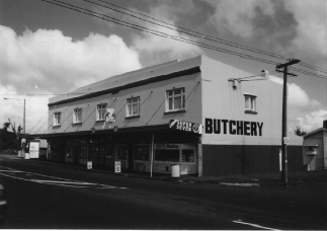
Wairiki Road shops, 1995
Fifty years ago, many goods were still kept in bulk and weighed out for the customer. A row of biscuit tins sat in front of the counter and you had a choice of half a dozen — roundwine, gingernuts, malt digestive, chocolate chip and chocolate-coated. What was number six? Ah, that was the tin of broken biscuits, a mixture which could be bought at a reduced price.
Eggs were another item which were sold loose. Their price varied considerably during the year. Many households in the suburbs still kept a few hens of their own. It was quite common (for those who could afford it) to bulk buy a few dozen eggs when they were cheap and preserve them. This was done by coating them thoroughly in a proprietary mixture such as Ovaline and then submerging them in a kerosene tin full of water. Kept in the cool of a basement, they would stay fresh for months and be used for baking.
Flour was still sold in fabric flour bags which found many uses in the home as pudding cloths, dusters, and so on. Convenience foods were just beginning to appear. There was a choice of three flavours of packet soups — pea, tomato and mulligatawny. Cheese was Chesdale cheese in a cardboard box, looking and tasting much like soap. By modern standards prices were low and variety restricted. Frozen foods had yet to appear and most housewives considered tins to be something to be used in an emergency. Their regular use would be a slur on their own housekeeping abilities. Butter had not yet been challenged by margarine and no-one had heard of yoghurt. A few things haven’t changed. Packets of jelly are still packed in waxed paper inside a carton. Edmonds Baking Powder is still available in tins with the picture of the factory building on the outside, and the Edmonds Cook Book has been in constant publication since 1907.
What has happened to that Four Square store? The building is now a pair of garages for the houses at the rear.
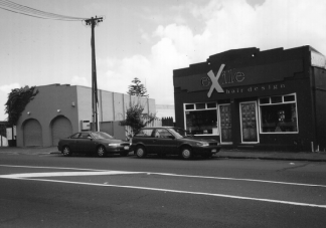
The garages on the left were the Four Square grocery
On the corner of Ellerton Road stood a haberdashery. Most children of today would not even know what the word means. It was run by two elderly women by the name of White. The local children regarded them as witches and hated going in as they made it very obvious that they hated children. It was a cluttered, untidy hodgepodge of a shop but they always seemed to have what you wanted in the way of buttons, pins and needles, and other sewing oddments. I have been told that they resented people waiting for the trams taking shelter under ‘their’ verandah and were actually known to have tossed a bucket of water over the legs of such ‘intruders’.
After their day the shop sat empty for many years before becoming the home of Jansens Pet Shop. It eventually became so successful it outgrew these premises and was forced to move further along Mt Eden Road near Winstone’s Quarry, where today it is the largest pet shop in the Southern Hemisphere! Today, after a few years as a Greenacres franchise office, the old corner shop is Jan Waite Hairdressing and Beauty Salon.
Going in the opposite direction up Mt Eden Road, there used to be a service station on the south-west corner of Balmoral Road. As traffic density increased, its location on a corner became a disadvantage and it ceased to exist. Some of the site was taken when the intersection was widened; the rest remains as a tiny reserve.
There is another larger block of shops above the Balmoral Road intersection but still within easy walking distance. It also had butcher, dairy, greengrocer, grocer, stationer, home bakery, haberdashery, hairdresser, plus a chemist’s shop. This close duplication of shopping facilities was typical of the time when people expected to be able to pop down the road and buy goods close at hand as they needed them. This pattern was dictated by several elements: the scarcity of goods which could be stored, either tinned or frozen; the absence of the car as a daytime ‘shopping basket’; the lack of refrigeration in the home; the generally low wages which meant housekeeping was often a hand-to-mouth business, and it was important to be able to get short term credit for small purchases. The personal element in shopping was also important: customers were known individually and catered for. However, for all major purchases, it was necessary to ‘go into town’ as larger local shopping centres like the Mt Eden village shops differed only in the number, not the type or size of shops there.
Queen Street was the real city centre. It was the transport hub because all the tram routes ran into town like the spokes of a wheel. It was Auckland’s misfortune that an outer ring never joined them all. If you wanted to travel from one suburb to another, you had to go into town and change trams, just as they want us to do again with Britomart. Today we are in an era of shopping malls, but fifty years ago was the era of the large department store. George Court’s and Rendells in ‘K Road’, John Court’s, Milne & Choyce, Smith & Caughey in Queen Street. The Farmers Trading Co in Hobson Street was served by its own free trams which ran along Hobson Street with their own terminals in Beresford and Wyndham Streets. Here the goods were kept safely away from all but visual inspection in glass encased counters. You had to ask a staff member to get out any item you wished to inspect more closely.
Money was taken in pneumatic tubes on the ceiling to a central cashier and your docket and change came rattling back.
As well there were Mackenzies and Woolworths — one step closer to the next stage of supermarkets — where long open-topped counters stretched the length of the shops and customers were free to handle and inspect the varied goods before paying the girls behind the counter.
The past fifty years have seen huge social changes. The population has increased at the same time as the average household size has decreased. The trend towards urbanisation has accelerated, and the number of women in the paid workforce is far above pre-war levels. Their increased spending power, coupled with their reduced time available for housekeeping, has fuelled the demand for convenience foods.
The essential difference is that 50 years ago food shopping involved the purchase of the raw materials for cooking. Today these fill only a small proportion of a supermarket’s shelves. The emphasis is on buying a finished product ready to serve. Both the product and the presentation have changed dramatically. You can buy at almost any time of the day or night. Service has been replaced by self-service. You are no longer separated from the stock by a counter but are free to browse, while the choice of goods has multiplied a thousandfold, with spices and ingredients an earlier generation never encountered.
If anyone is nostalgic for the ‘good old days’ let them remember the time spent weighing out individual orders, the lack of choice and the need to plan ahead for shopping-less weekends.
Strangely enough, there is today not one true supermarket in the centre of the two suburbs of Epsom and Mt Eden. Within easy reach — by car — is a circle of supermarkets/shopping malls at Greenlane, Royal Oak, Three Kings, St Lukes, Valley Road and Newmarket, but within this area the small shops still reign supreme.
By Muriel Williams
The phone rang, but that was later in the story.
‘Mrs Kendon, if you keep feeding my dog, I’m going to take you to Court.’ ‘I’m sorry,’ said my mother, ‘But Peter keeps on turning up here after you take him home each time.’
‘Well, you must send him home. He’s a show dog on a very special diet and if you keep on encouraging him, he won’t win the first prize and I’ll blame you completely.’
Mother put down the phone and turned to us: ‘Now we’re in real trouble,’ she said. It was all our fault.
We lived right beside One Tree Hill in Lewin Road, with a gate into the park, and we were allowed to roam free all over the wonderful hill. Of course we knew which was One Tree Hill and which was Cornwall Park, with a stone wall between the two. In fact we knew every inch of the huge area.
There was a golf course on One Tree Hill with a bunker just over the fence from our tennis court. Every now and then a ball came over the fence and into our garden. My brothers (Murray and Phil) and I used to pick up these balls and offer them back to the owners for the small fee of twopence.
One day we had collected fourpence, and went for a walk up One Tree Hill where we met a man with a dog. ‘What a lovely dog,’ we said, ‘what’s his name?’ ‘Rosie,’ he replied, patting the head of the beautiful red Airedale terrier.
‘I wish we had a dog like this,’ I said. ‘Would you like to buy it?’ he asked.
‘Oh, yes, but we’ve only got fourpence,’ we replied in unison. ‘That’s okay,’ he replied, and we handed over our hard earned cash and took Rosie home with us.
‘Look at our lovely dog,’ we called out to mother. ‘His name is Rosie and he’s hungry.’ Mother was always good with animals and soon found something for it to eat.
Little did we know that Rosie was actually a bitch on heat, until later that evening when we heard a lot of dogs barking outside. By this time Dad had come home, so he locked Rosie in the wash-house and told the other dogs to go home, but to no avail. They barked all night, and in the morning Dad took Rosie away and we tried to get rid of all those dogs. There were all sorts — spaniels and fox terriers, mongrels and a couple of pomeranians. Some of them went home, but a few stayed around our place so Dad inserted an advertisement in the evening paper. We received phone calls from all over the city. One man came all the way from Ponsonby, and another from Remuera to pick up their pets. Even after this, there were a couple of strays left who liked our place, but one of the neighbours was so annoyed with losing his night’s sleep, that he laid some poison, and two of these died — one underneath the wash-house steps — and the rest vanished.
However, the people who came from Remuera had collected their pomeranian named Peter, and told mother he was a prize dog on a strict diet as they were preparing him for the next show. The lady actually accused mother of ruining his chances of first prize as she had given him the wrong food.
A couple of days later, Peter came running up the path, looking very pleased with himself. Of course we patted him, as he was such a nice animal, but soon the owners phoned again as they guessed he must have returned to our place.
‘I can’t understand it,’ the lady said. ‘We locked him in the wash-house when we came home, and fed him his correct diet, but when I opened the door this morning, he rushed out and ran away, evidently coming straight over here. Now you must not encourage him or there will be trouble.’
They called for Peter again, and mother promised not to encourage or feed him if we ever saw him again. This happened two or three times until Dad received a lawyer’s letter, threatening to sue him for harbouring their dog. This really upset our parents and they decided we really had to discourage Peter if he came back again.
The next day mother was watering the garden, when the familiar animal ran up the path, with his tail wagging and a look of joy on his face. Instead of patting him, mother turned the hose on him, and when he realised she meant it and that it was not a game, his expression changed completely. And he slowly turned and walked back down the drive and out the front gate with his tail between his legs. Mother felt as though she had knifed her best friend in the back, and we never saw Peter again.
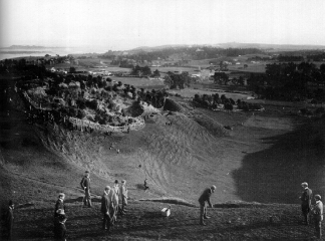
The Maungakiekie Golf Links, 1902
By Helen Laurenson
When civil engineer Peter William Barlow was writing Kaipara or Experiences of a Settler in North New Zealand, for publication in 1888, he recalled his first impressions of the Auckland township in 1883.
Of places of public amusement, with the exception of a dingy little theatre very seldom used, and a so-called opera house where occasional performances take place, it has virtually none and to this fact is undoubtedly to be ascribed the large amount of drunkenness that exists.
Barlow, together with his family and a servant girl, had landed at the port of Auckland on 3 July 1883. Under engagement to a land company, Barlow spent several months in the town, and included a short visit to the Waikato, before moving north with his family and settling in Matakohe. Born in 1847, and educated in England, he had been employed on contracts in Turkey and Brazil, as well as on the Tower subway in London. He wrote amusingly about his time in the colony, and his observations still make interesting reading. His return visit to Onehunga by train, for a day’s shooting, cost him 2/6, and he was not at all impressed by railway travel to that destination — ‘three quarters of an hour of the roughest railway travelling I had ever experienced’,2 when he had thought that it would be quicker than the same trip by omnibus. He was hoping to shoot curlews, and would even have settled for a godwit, but instead bagged a kingfisher, which he later had stuffed. He was impressed neither with the reports of ‘grand curlew shooting’, nor with the Port of Onehunga.
He and his wife climbed Mt Eden, however, and Barlow remarked on its crater formation, and the magnificent view of the isthmus. Having descended, they spent some time examining possible houses for sale in the neighbourhood. They were:
much struck by the elegant timber villa residences, surrounded by spacious verandahs, about which flowering creeping plants of various kinds, such as the yellow Banksia rose and the passion fruit with its splendid scarlet flower, climbed and hung in luxurious festoons.
Interestingly, he predicted for the area north of Auckland that ‘wine-making will one day become a leading industry. The olive also grows remarkably well and I fancy I see another industry sticking out in that direction’. Sadly, Barlow died in April, 1890, after only seven years in New Zealand.
From Barlow’s viewpoint, the lack of a lively theatre scene in Auckland in 1883 was clearly disappointing. When some later writing on the history of theatre in New Zealand is set alongside his con-temporary observations, however, a differing opinion appears on entertainment in the 1880s:
High summer of our theatrical history was the period between 1880 and the First World War for New Zealand theatre has always been indissolubly tied to its Australian counterpart. During the period under survey, hundreds of first-class artists from all parts of the world visited this country.
Which of the two differing views of Auckland’s theatre in the 1880s was the more accurate? Was it as Barlow suggests, a dreary scene, or alternatively was public entertainment in its heyday?
The Theatre Royal, which stood on the southern corner of Queen Street and Victoria Street West, and Abbott’s Opera House, later Fuller’s Opera House, on the corner of Elliott Street and Wellesley Street West, were the two listed by Barlow as Auckland’s ‘places of public amusement’ in 1883. Both were lit by gas, with Abbott’s Opera House seating 1300 comfortably, and the Theatre Royal, 1500.
Amusements comprised many and varied forms of entertainment, for the lines of demarcation between different genres of the theatre were flexible, and not strictly drawn. In 1883, popular theatre included an array of variety shows, concerts, opera, opera bouffe, melodrama, minstrel shows, dioramas, lectures and more, as the increasing commercialisation of entertainment and leisure activities outside the home continued. This entertainment was not necessarily at a level which might currently be implied by ‘high-brow’ theatre. Performances of major works such as ‘King Lear’ were ruthlessly shortened, and colourful tableaux often used to convey action. A ‘Living Chess Tournament’ in aid of St Andrew’s [Presbyterian Church] Building Fund, with the stage laid out as a chessboard, and tableaux, illuminated by limelight effects ‘greatly heightened by the burning of magnesium wire’, played to crowded houses in Abbott’s Opera House in September 1883. There was an emphasis on popular melodrama, and also on a changing bill of fare, so that many tastes might be catered for, and as wide an audience as possible, attracted.
‘Amusements’ was the heading under which advertisements for performances at both Auckland theatres appeared in The New Zealand Herald. Occasionally, announcements for alternative entertainments also featured, such as circuses, or a carnival at the Devonport Racecourse with ‘Aborigines from the wilds of Queensland’, for there were other venues where entertainment could be presented. The Choral Hall, which still exists in Symonds Street as part of the University of Auckland, was among those buildings in which recitals, concerts, lectures and other presentations were held. The consistent use of district and church halls for local amateur performances, frequently recorded and evaluated at some length in the newspapers of the time, also played a significant role in the provision of public entertainment.
Among the many such occasions featured during 1883, two are reported in both The New Zealand Herald and the Auckland Star as taking place at the ‘Epsom Public Hall’ in Manukau Road, recently shifted to a site donated by William Gardner, almost opposite Onslow Avenue. The first — an ‘Entertainment, Musical and Literary . . . in aid of the Building Fund’ was held on 5 January 1883. Already, when the doors opened at 7.30pm, and before proceedings began at 8pm, a Keir’s horse-drawn bus had left the Union Bank in Auckland township at 7pm, on its way to Epsom, and was due to pass Windmill Corner ten minutes later and pick up any patrons waiting by Partington’s Mill, which stood at the corner of Karangahape Road and Symonds Street. Across the road was the site of the proposed wooden footbridge, which was to span Grafton Gully within a couple of years.
It would seem that although attendance at the rather lengthy programme of vocal and recitation items was only ‘very fair’, and the evening was not a financial success, events took a different course when the hall was cleared for dancing at 10.30pm. It is recorded that ‘this active physical exercise was kept up with keen delight until the breaking of the new day’ with Mr Garland as Master of Ceremonies. According to prior advertising, the bus was scheduled to return to Auckland ‘after the entertainment closes’. Despite the obvious success of the dance, for which the much vaunted musical and literary entertainment seems but a prelude, one would imagine that the chartered bus-driver would not wait around until dawn for his passengers. No doubt, with lanterns lit in the summer darkness, the horse-bus would have resolutely retraced its way along the road back to Auckland by midnight.
The second reported occasion took place in the Epsom Hall nearly six months later, on Tuesday 22 May 1883, when, for one night only, and also in aid of the Epsom Hall fund, the Black Diamond Minstrels presented ‘new songs, new dances, new jokes’ and ‘fun without vulgarity’. They included E. Salt, F. Pitt, F. Perrot, who was also the manager of the troupe, ‘Messrs Blanchard and Stowell in their celebrated song and dance Days When I was Young; H. Elder in the Hornpipe; Sam Blanchard in The Big Sun Flower; Stowell in his famous clog dance; H. Roberts’s Grand solo on the whistle’. The stage was set for ‘Eleven men in the chairs; Trouble begins at 8’.
But in fact ‘trouble’ did not begin until 8.30pm, on that wet and stormy May night. The omnibus ordered for the performers was too small to bring them all out to Epsom, so some cheerfully undertook the long walk through the mud, which made them late. When this was explained to the audience, which comfortably filled the Hall, ‘their impatience changed to feelings of sympathy for those who were ‘trudging’ through the puddled roads . . . and the performers were greeted with rounds of applause when the curtains rose’. It was a very successful evening and the enthusiasm of the audience was unmistakable. The Herald reporter commented
The troupe is undeniably a talented one . . . a good many of their excellent jokes gave additional enjoyment from their very local application, and when the names of well-known residents were adroitly introduced, the audience became convulsed with laughter . . . the troupe may always expect a welcome and a good reception in Epsom under any circumstances, or by any arrangement.
Once again, at 10.30pm the Hall was cleared, and dancing continued until 2.30am, with those enjoying themselves ‘wholly indifferent to the raging elements without. The only thing to mar the enjoyment of the dance was the fact that prevailing numbers made the gentlemen at a discount, and the ladies consequently stood at a high premium’. Which presumably means that the men outnumbered the women — still a fact of life in New Zealand at this time.
The New Zealand Herald coverage of such performances took a much more respectful tone than that of the Bulletin, a weekly, radical journal, and the voice of Australian nationalism, which had been founded in 1880. It ran a regular column ‘Sundry Shows’, which dryly commented on the local Sydney theatre scene with such statements about one amateur performer as ‘[s]omething alive inside a coat played Mr Icebrook. This was labelled Dr Byrnes’. The New Zealand Herald occasionally printed such critical comments as ‘the voice of the prompter indicated too frequently that the season began without sufficient rehearsal’, or the play was ‘hackneyed’ and ‘the Theatre Royal has been occupied by polemical discussions, political harangues and undramatic performances’. Reviews were generally polite, however, and the Herald critic often quoted Australian newspaper reviews of productions before the opening of a theatre season in Auckland; promotional material supplied in advance by enterprising theatrical agents was clearly used in newspaper advertising on both sides of the Tasman.
Such publicity, with its rhetoric of scale and importance, where the word ‘grand’ was frequently used, stands in interesting contrast to Barlow’s dismissive comment on the size and significance of the two Auckland theatres. After a very successful Auckland season in 1883, actor Miss Jennie Lee wrote a letter of thanks to ‘the Press of Auckland’ in which she stated ‘I am sure Auckland should be proud of its Opera House. I have to thank Mr Abbott for building the brightest, cheeriest and best appointed theatre I have played in for a long time’.The Bulletin early in 1883 announced the opening of a dramatic agency in Sydney with connections to ‘all the big cities and towns of the group’ including the leasing of Abbott’s Opera House New Zealand ‘one of the prettiest theatres in this Hemisphere’.
The main centres in New Zealand, although steadily growing, were at most a tenth the size of either of Sydney or Melbourne. Australia’s estimated population at the end of 1883 was 2,505,736, and at the same time, the total estimated population of New Zealand, exclusive of Maori, was 540,877 persons. Despite Sir Julius Vogel’s immigration policies, which had caused a doubling of population between 1871 and 1880, by December 1883 Auckland’s population was estimated at 27,315, Wellington’s at 22,160, Christchurch’s, 16,069, and Dunedin’s 25,804.
The 1880s were hard times in New Zealand, with a litany of depression including ‘declining prices for its exports of wool, a diminishing output of gold, a high level of indebtedness, both private and public, low and falling wages, unemployment and destitution in the towns’.
As Barlow commented, there were indeed periods in Auckland when both Abbott’s Opera House and the Theatre Royal were closed, the latter often for weeks on end. The Herald reported at the end of January 1883 that ‘both theatres have been closed for a considerable part of the month. Heywood’s All Star Co. have played a short season at the Royal but they did not do very good business’. After Fanny and Martin Simonsen’s four week March season at the Theatre Royal, during which they had problems, and were forced to cancel performances from Monday to Friday of their last week in Auckland, the Theatre Royal staged no performances from 17 March to the 30th, and from 7 April until halfway through May. It was closed for periods in September and October, and Abbott’s Opera House was also closed at times.
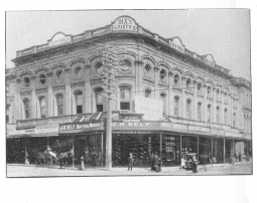
Above: Theatre Royal
Below: Abbott’s Opera House
[Source Cyclopedia of New Zealand: Vol 2, Auckland Provincial District, 1902.]
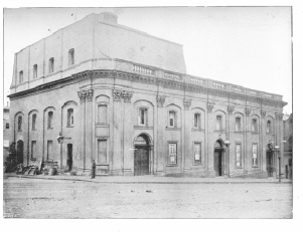
Among theatregoers in Auckland in 1883, there existed a disruptive element who patronized the theatre pit and interrupted performances. The Herald reporter writing about the Epsom performance of the Black Diamond Minstrels stated ‘one exceedingly pleasant feature about the affair was a total absence of that horrid discordant “whistling” which has lately been so disagreeably prevalent at nearly every entertainment in the suburbs of Auckland . . .’ The larrikins in the theatre pit were considered ‘rude’ with their ‘disorderly conduct and hideous cries’ and the suggestion was made after a farewell benefit concert for Gerald Dillon in Abbott’s Opera House, that a couple of policemen might be appointed, or the entry price raised from 1/- to 2/6 ‘as has been found effective on former occasions’. Later an attendant was employed as a ‘security guard’, and the problem was ‘effectively suppressed’. During a well attended performance in the Newmarket Hall by Mr Martin Swallow’s Concert Company, ‘Come t’adoro sung by Signor Antonelli raised up cat calls and other detestable noises . . . Mr Swallow himself did not lose the opportunity of manifesting what he thought of some of his patrons for the evening’.
In their delight in deliberately offending the respectable section of the audience, larrikinism indicated a shared experience of youth in high-spirited reaction to their indignant elders, a problem clearly visible when the level of unemployment was rising within an increasingly urban environment.
The urbanisation of society, so clearly underway in the 1880s, can be seen as reflected in the enormous popularity of ‘gift enterprises’ which, as part of a variety performance, offered substantial prizes, even extending on one occasion in Auckland to a rosewood piano ‘worth 35 guineas’. The gifts were of a distinctly domestic nature and attractive to women; they were usually suites of furniture for lounge or bedroom, with oil paintings, and silver (plated) tea and coffee services or women’s and men’s pocket watches and even a chest of tea. These giveaway evenings, with their significant element of consumerism, presented the anticipation and excitement, which attends any ‘free offer’. Hardly conforming to today’s definition of theatre, they nevertheless were very well attended in Auckland; such amusements, especially those where ‘everyone who attends will receive a present’, would no doubt have been just as appealing for society then as today’s advertisements for ‘Lotto’ and other minor forms of gambling would serve to suggest.
Sometimes gift evenings were associated with the presentation of dioramas, which, unrolling their colourful painted scenes across the stage to the accompaniment of special lighting and musical effects, together with narrated information, conveyed the excitement of recent happenings in the world, or focused on faraway centres of culture such as the Holy Land. They were a dramatic and entertaining way of conveying information to theatre-goers.
The role of theatre as a public instructor is clearly demonstrated in Auckland, as ‘qualified’ speakers brought their neatly crafted perform-ances in clearly defined series and presented them to appreciative audiences. War correspondent Archibald Forbes gave his course of four lectures ‘Experiences of a War Correspondent’, ‘Kings and Princes I have met’, ‘Warriors I have known’, and ‘All Europe in Arms’ under the heading ‘He shall stand before Kings’ at Abbott’s Opera House, and in Sydney. He also delivered them on a circuit which included smaller towns in both Australia and New Zealand as well as the main centres. Dr Anna Potts, MD, an American, delivered a series of lectures on health topics at the Theatre Royal, when all parts of the house were filled ‘uncomfortably’ in the evenings, but afternoon sessions were for ‘ladies’ only. An element of pseudo-science seems to have been present as well as physiological charts and a skeleton, for she also entertained the audience by reading the character of two male volunteers using physiognomy.
The great variety of theatre presentations in Auckland during 1883 is reflected in a contrasting Theatre Royal programme earlier in the year, which had interesting historical and cultural dimensions. On 31 January, for three nights there were:
Grand Maori War dances and Hakas by the released Maori prisoners from Parihaka, imprisoned with Te Whiti and Tohu. An entirely novel entertainment — programmes of songs and dances in which any approach to indecency will be carefully avoided . . . The new prayers by Te Whiti and the celebrated song that was sung when the first fence was pulled down at Parihaka will be given by the natives in a body.
The performance was reviewed kindly, but by the last night, attendances were ‘not very large’ for this early Maori ‘concert party’. Nevertheless the group were warmly farewelled as they travelled through Queen Street on their way to the marae where they had been staying at Mangere.
A shared experience for the community of Auckland marked Jennie Lee’s triumphant, two-week season of ‘Jo’. It was an adaptation of Charles Dickens’s Bleak House, in which she played a young boy crossing-sweeper, and was enthusiastically received at Abbott’s Opera House. Hundreds were reported as turned away, according to the advertisements in the Herald, and a special train was put on at excursion rates from Onehunga. The season began on Tuesday 24 April 1883. The following Saturday night, the theatre was ‘crammed’ with the ‘largest audience ever present on one night to witness a theatre performance in the city’ with Miss Jennie Lee ‘not afraid even to indicate some of the worst symptoms of squalor’. The house, ‘estimated to hold £125 when the audience is seated, £130 is a “crowded house”’ took ‘£136 on Saturday’ with prices at 4/- Dress Circle, 2/6 Stalls, and 1/- Pit. By popular demand she played two more performances of ‘Jo’ at the end of her season of ‘La Cigale’. That could mean that of the population of Auckland in 1883 (27,315), approximately 15,600, or more than half, attended a performance of ‘Jo’ even allowing for those in the population who would never attend the theatre, and those who might have attended ‘Jo’ more than once. The patronage of the newly appointed Governor, His Excellency Sir William Jervois, who attended a special command performance, assured the overwhelming success of ‘Jo’. It was not therefore surprising that the Theatre Royal had given up the unequal struggle, closed its doors and was available for lease.
Abbott’s Opera House began and ended the year with pantomimes presented by travelling Juvenile Opera Company performers. The Theatre Royal opened 1883 with performances by Heywood’s Novelty All Star Company in which ‘Mr Heywood’s wonderful soprano voice was tested severely by the operatic and other selections he sang’. On 31 December 1883, the Theatre Royal had its doors open all hours, as it staged the ‘Great Six Day walking Contest’ featuring ‘Wllm Edwards the famous Australian Champion v. H. Huckstep & the Bros. Henry’. When Barlow had arrived early in July, Abbott’s Opera House was the venue for a return season of the American War Diorama and Gift Evening — previously shown in Auckland four years previously — and the Theatre Royal was offering Mr Pooley’s popular amateur concerts only on Saturday nights. Barlow was indeed accurate in observing that these two main theatres in Auckland were closed for periods during 1883. What his statement did not reflect, however, was that despite these closures, and bearing in mind the size of the population of Auckland, there was a considerable number of amateur musical, dramatic and other entertainments, which were offered during that year.
As well as in the two main theatres and the Choral Hall, they were presented in a variety of venues, from the Lorne Street Hall to church, school, and district halls, such as the Epsom Hall in what now comprises suburban Auckland. Even within a climate of economic depression, the theatre offered an affordable, accessible and varied entertainment, which brought people together in Auckland in a shared leisure experience. Theatre in its many forms was an expression of the culture with which most of them would be familiar, a culture which had been transported and transplanted into this new and unfamiliar colonial environment.
References